Sound is an essential part of our daily lives. From conversations and music to alarms and natural sounds, we experience sound everywhere. But have you ever wondered how sound travels from one place to another? The answer lies in the concept of waves. Sound travels in the form of waves, and specifically, sound waves are longitudinal waves. Understanding this concept helps us explore the nature of sound and how it behaves in different environments.
What Are Sound Waves?
Sound waves are a type of mechanical wave that require a medium to travel. This medium can be air, water, or even solid materials. Sound is produced when an object vibrates, causing the surrounding particles to vibrate as well. These vibrations travel through the medium in the form of waves until they reach our ears, where they are interpreted as sound.
What Are Longitudinal Waves?
Longitudinal waves are waves in which the particles of the medium vibrate in a direction parallel to the direction of wave propagation. This means that the movement of particles is in the same direction as the wave itself.
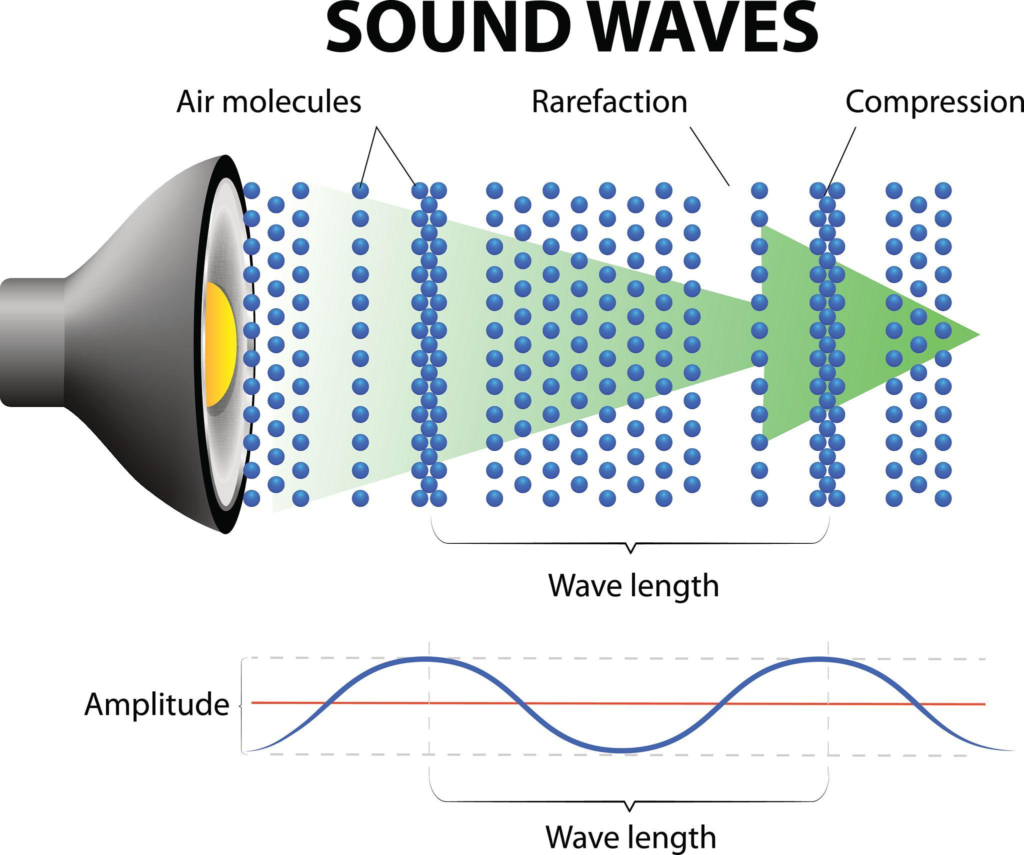
In longitudinal waves, there are two important regions:
- Compression: Areas where particles are close together, resulting in high pressure
- Rarefaction: Areas where particles are spread apart, resulting in low pressure
These alternating compressions and rarefactions move through the medium, allowing the sound to travel.
How Sound Waves Travel
When an object vibrates, it pushes nearby particles, creating a compression. These particles then push the next set of particles, passing the energy forward. After moving forward, the particles return to their original position, creating a rarefaction. This continuous process of compression and rarefaction forms a longitudinal wave.
For example, when you speak, your vocal cords vibrate. These vibrations create sound waves that travel through the air and reach the listener’s ears. The particles in the air do not travel long distances; instead, they vibrate back and forth, transferring energy.
Longitudinal vs Transverse Waves
To better understand sound waves, it is useful to compare longitudinal waves with transverse waves.
- In longitudinal waves, particle movement is parallel to wave direction (e.g., sound waves).
- In transverse waves, particle movement is perpendicular to wave direction (e.g., light waves or waves on water surface).
This key difference explains why sound behaves differently from other types of waves.
Why Sound Needs a Medium
One important property of sound waves is that they cannot travel through a vacuum. Since sound depends on the vibration of particles, it requires a medium with particles to transfer energy. In space, where there is no air or particles, sound cannot travel.
However, sound can travel through solids, liquids, and gases. In fact, sound travels fastest in solids because the particles are closely packed, allowing energy to transfer more quickly.
Real-Life Examples of Longitudinal Sound Waves
- Human Voice: Vibrations of vocal cords produce sound waves in air
- Musical Instruments: Instruments like drums and guitars create vibrations that produce sound
- Ultrasound: Used in medical imaging to view internal organs
- Seismic Waves: Some waves during earthquakes are longitudinal in nature
These examples show how important longitudinal sound waves are in both daily life and scientific applications.
Importance of Understanding Sound Waves
Understanding that sound waves are longitudinal helps in many fields such as physics, engineering, medicine, and communication technology. It explains how microphones, speakers, and hearing devices work. It also helps scientists study wave behavior and improve sound-related technologies.
Key Points to Remember
- Sound waves are mechanical waves
- They require a medium to travel
- Particle motion is parallel to wave direction
- They consist of compressions and rarefactions
- They cannot travel through a vacuum
Sound waves are a perfect example of longitudinal waves, where particles vibrate parallel to the direction of energy transfer. This unique motion creates compressions and rarefactions that allow sound to travel through different mediums. Understanding this concept not only explains how we hear sounds but also highlights the importance of waves in science and technology. From simple conversations to advanced medical tools, longitudinal sound waves play a vital role in our everyday lives.
For More Information and Updates, Connect With Us
- Name Survi kumari
- Phone Number: +91-7488713635
- Email ID: survi.eeplclassroom@gmail.com
- Our Platforms:
- Digilearn Cloud
- EEPL Test
- Live Emancipation
- Follow Us on Social Media:
- Instagram – EEPL Classroom
- Facebook – EEPL Classroom
Stay connected and keep learning with EEPL Classroom!

Leave a Reply