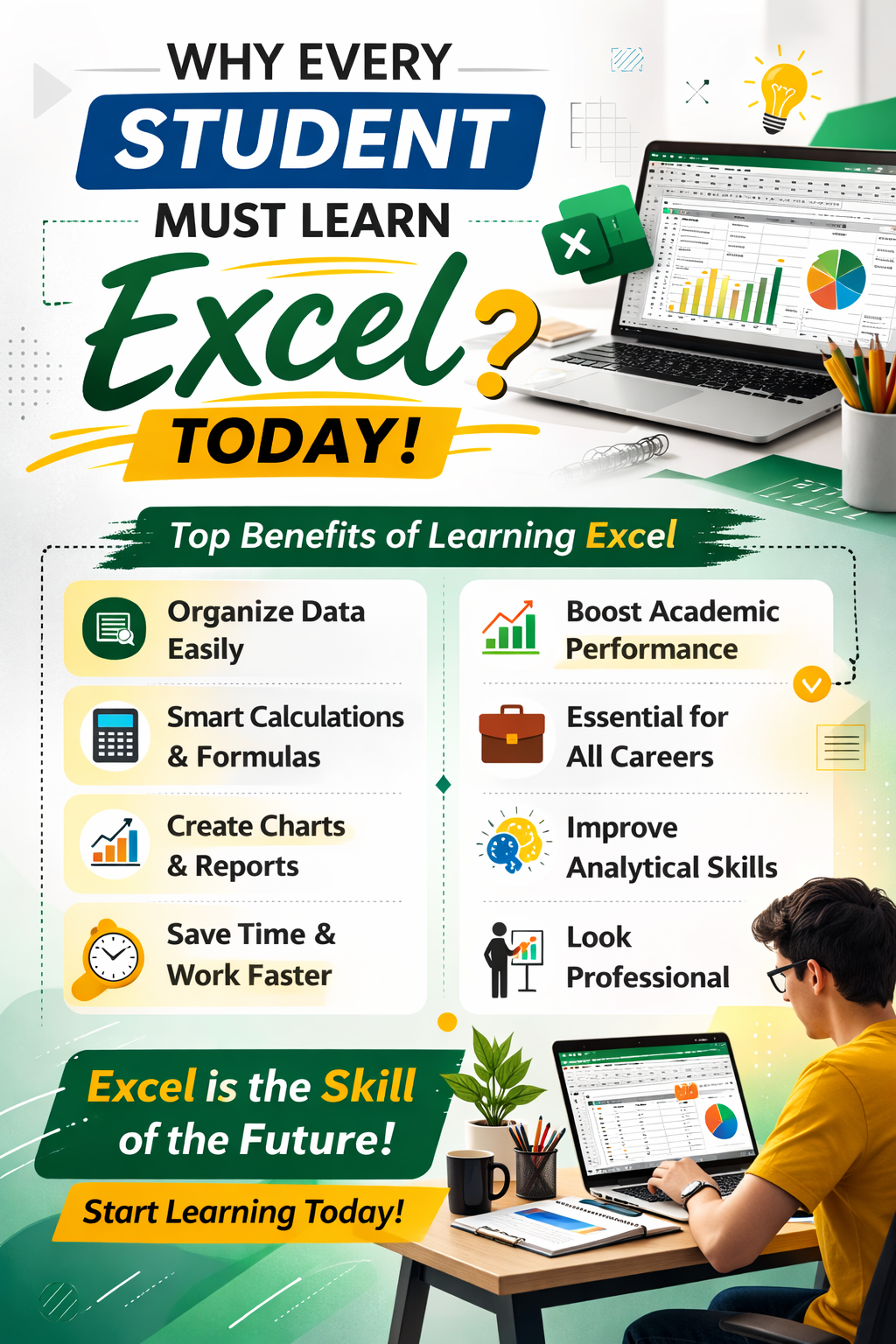
In today’s fast-moving digital world, academic knowledge alone is not enough for success. Students are expected to develop practical skills that help them manage data, analyze information, and work efficiently. One such essential skill is Microsoft Excel. Once considered a tool only for accountants and office professionals, Excel has now become a must-learn skill for students of all streams. Learning Excel early can give students a strong advantage in academics, careers, and everyday life.
Excel Is a Universal Skill
Excel is used almost everywhere—schools, colleges, offices, businesses, research labs, and even startups. From maintaining attendance sheets to analyzing business data, Excel plays a vital role. Because it is used across industries like IT, finance, marketing, education, and data analysis, Excel is a universal skill that benefits students regardless of their career goals.
When students learn Excel, they gain a tool that remains useful throughout life.
Improves Data Understanding and Organization
Students deal with data every day—marks, schedules, project details, expenses, and study plans. Excel helps organize this information neatly using rows, columns, tables, and charts. Instead of messy notebooks or scattered notes, Excel allows students to store and manage data efficiently.
Learning Excel also improves understanding of data patterns, comparisons, and trends, which is especially useful for subjects like mathematics, economics, and science.
Boosts Academic Performance
Excel can be a powerful academic support tool. Students can use it to:
- Track study schedules
- Analyze test scores
- Create charts for projects
- Perform calculations quickly
- Prepare assignments neatly
For school and college projects, Excel helps present information professionally. This not only saves time but also improves the quality of submissions and presentations.
Essential for Future Careers
Almost every job today requires basic Excel knowledge. Employers expect candidates to know how to work with spreadsheets, formulas, and data. Students who already know Excel have a clear advantage during internships, campus placements, and job interviews.
Fields like data analysis, finance, business management, engineering, marketing, and administration heavily rely on Excel. Even beginners with good Excel skills are often preferred over those without them.
Builds Analytical and Logical Thinking
Excel is not just about typing data—it’s about thinking logically. Using formulas, functions, and charts helps students develop analytical skills. They learn how to solve problems step by step, analyze results, and make decisions based on data.
This logical thinking ability improves problem-solving skills, which are valuable not only in careers but also in daily life.
Saves Time and Increases Efficiency
Manual calculations and repetitive tasks take time and increase the chance of errors. Excel automates calculations and organizes information quickly. Tasks that may take hours manually can be completed in minutes using Excel formulas and tools.
Students who use Excel smartly can manage time better and focus more on learning instead of repetitive work.
Helps in Competitive Exams and Higher Studies
Many competitive exams and professional courses require data interpretation, statistics, and logical reasoning. Excel practice strengthens these concepts. Students pursuing higher studies in commerce, management, science, or technology benefit greatly from Excel familiarity.
Excel also helps during research work, surveys, and project analysis at college and university levels.
Encourages Practical Learning
Excel turns theoretical concepts into practical learning. Students don’t just read numbers—they work with them. Creating charts, graphs, and dashboards makes learning interactive and engaging. This practical exposure increases interest and confidence in handling real-world data.
Easy to Learn and Beginner-Friendly
One of the biggest advantages of Excel is that it is easy to start. Students can begin with basic operations like adding data and gradually move to advanced features such as formulas, charts, and data analysis tools. No programming background is required, making Excel suitable for beginners of all ages.
Builds Confidence and Professionalism
Students who know Excel appear more confident and professional. Whether it’s preparing a report, managing data, or presenting information, Excel skills make students stand out. This confidence helps during presentations, interviews, and teamwork situations.
In a world driven by data and technology, Excel is no longer optional—it is essential. Every student, regardless of stream or career plan, must learn Excel to stay relevant and competitive. It improves academic performance, builds logical thinking, supports career growth, and makes everyday tasks easier. Learning Excel today is not just about software—it’s about preparing for a smarter, more efficient future.

For More Information and Updates, Connect With Us
- Name Sumit singh
- Phone Number: +91-9835131568
- Email ID: emancipationedutech@gmail.com
- Our Platforms:
- Digilearn Cloud
- EEPL Test
- Live Emancipation
- Follow Us on Social Media:
- Instagram – EEPL Classroom
- Facebook – EEPL Classroom
Stay connected and keep learning with EEPL Classroom!
Leave a Reply