Tag: tech importance

  • Centre of Excellence in Ranchi – EEPL Ranchi Driving Innovation and Skill Development

    EEPL Ranchi has emerged as a transformative force in technical education through its Centre of Excellence initiative in Ranchi. In a rapidly evolving technological landscape, industries demand professionals who are not only academically strong but also practically skilled. The Centre of Excellence (CoE) by EEPL Ranchi bridges this gap by creating an ecosystem where innovation, hands-on training, and industry collaboration come together.

    What is a Centre of Excellence?

    A Centre of Excellence is more than just a training facility. It is a dedicated hub designed to foster advanced learning, research, skill enhancement, and innovation in specialized domains. At EEPL Ranchi, the Centre of Excellence is structured to empower students, young professionals, and entrepreneurs with real-world technical competencies that align with current industry standards.

    With Ranchi emerging as a growing educational and industrial hub in Ranchi, the need for advanced technical training infrastructure has never been greater. EEPL’s initiative addresses this demand by equipping learners with cutting-edge tools, modern labs, and mentorship from experienced professionals.

    Vision Behind EEPL Ranchi’s Centre of Excellence

    The primary vision of EEPL Ranchi’s Centre of Excellence is to create industry-ready professionals. The program focuses on:

    • Practical exposure to modern technologies
    • Industry-aligned curriculum
    • Research and development opportunities
    • Innovation-driven learning
    • Entrepreneurship support

    Rather than relying solely on theoretical teaching, the Centre promotes experiential learning. Students work on live projects, simulations, and case studies that mirror real industry challenges.


    Key Focus Areas

    The Centre of Excellence at EEPL Ranchi offers specialized programs tailored to high-demand sectors. These may include:

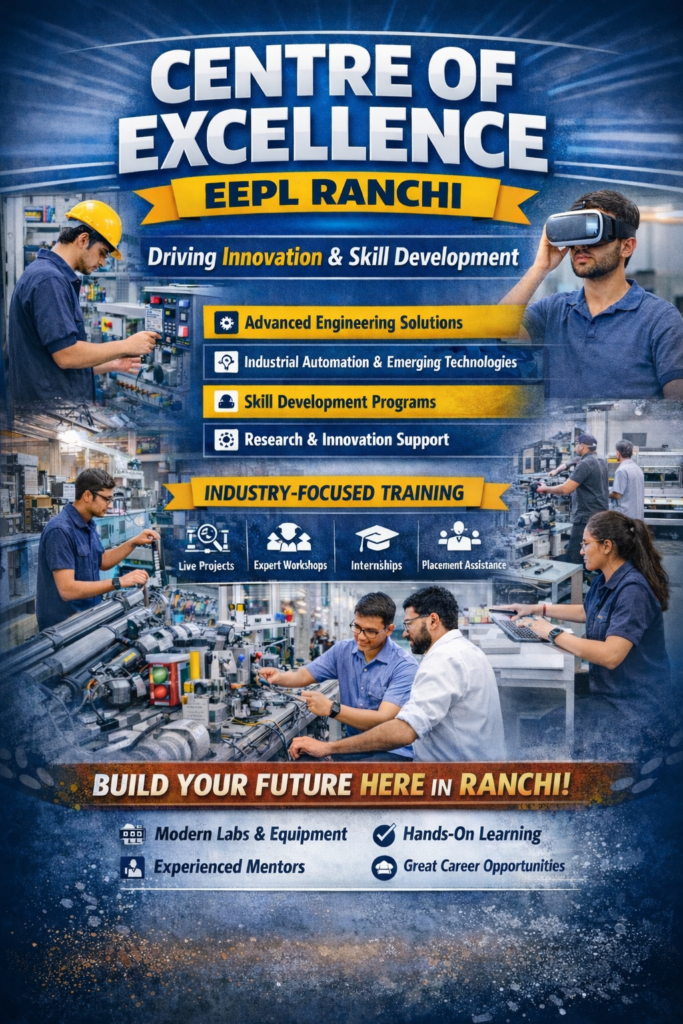
    1. Advanced Engineering Solutions

    Students gain exposure to practical engineering applications, system design, troubleshooting, and project execution. The focus is on solving real technical problems using modern tools and methodologies.

    2. Industrial Automation & Emerging Technologies

    With industries increasingly adopting automation, the Centre provides hands-on training in automation systems, control technologies, and smart solutions.

    3. Skill Development & Certification Programs

    Short-term certification courses help students enhance employability. These programs are structured to meet industry expectations and improve placement opportunities.

    4. Research & Innovation Support

    The Centre encourages innovative thinking by supporting student-led research projects. Mentorship programs help learners convert ideas into workable prototypes and scalable solutions.

    Industry Collaboration and Exposure

    One of the strongest pillars of EEPL Ranchi’s Centre of Excellence is its industry-oriented approach. The Centre collaborates with industry professionals to design training modules that match current market needs.

    Students benefit from:

    • Guest lectures by industry experts
    • Industrial visits
    • Live project implementation
    • Internship opportunities
    • Placement assistance

    This industry integration ensures that learners do not just acquire knowledge but also understand workplace expectations, professional ethics, and project management skills.


    Infrastructure and Learning Environment

    A Centre of Excellence must provide a technologically advanced environment. EEPL Ranchi has developed modern labs and technical setups that replicate real industrial systems. The infrastructure supports:

    • Practical experimentation
    • Simulation-based learning
    • Prototype development
    • Collaborative team projects

    The environment is designed to encourage curiosity and innovation. Students are motivated to explore, test, fail, and improve — an essential process for meaningful learning.


    Impact on Students and the Region

    The Centre of Excellence is playing a significant role in strengthening the technical ecosystem of Ranchi and the broader region of Jharkhand. By nurturing skilled professionals locally, EEPL Ranchi contributes to regional economic development.

    Students trained at the Centre:

    • Gain higher employability
    • Develop problem-solving capabilities
    • Build confidence through hands-on experience
    • Become industry-ready professionals

    For many aspiring engineers and diploma holders in Ranchi, the Centre provides access to advanced training without needing to relocate to metro cities.


    Why Choose EEPL Ranchi’s Centre of Excellence?

    Here are some compelling reasons:

    ✔ Industry-focused training
    ✔ Experienced faculty and mentors
    ✔ Practical learning approach
    ✔ Modern technical infrastructure
    ✔ Strong placement support

    EEPL Ranchi stands out because it understands that today’s education must evolve with industry. Its Centre of Excellence is not just about training—it is about transformation.


    Looking Ahead

    As technology continues to evolve, Centres of Excellence will become essential pillars of skill development. EEPL Ranchi aims to expand its offerings, introduce newer technologies, and strengthen industry partnerships in the coming years.

    The goal is clear: to position Ranchi as a growing hub of technical excellence and innovation. Through continuous improvement and a commitment to quality education, EEPL Ranchi’s Centre of Excellence is shaping the next generation of skilled professionals ready to contribute to India’s industrial growth.


    The Centre of Excellence at EEPL Ranchi represents a forward-thinking approach to technical education. By combining practical exposure, industry collaboration, and innovation-driven learning, it creates opportunities for students to thrive in competitive environments.

    For aspiring engineers and technical professionals in Ranchi, EEPL’s Centre of Excellence is more than a training center—it is a gateway to a successful and future-ready career.

    For More Information and Updates, Connect With Us

    Stay connected and keep learning with EEPL Classroom!

  • The Future Belongs to Multi-Skill Students

    The world is changing faster than ever before. Technology is evolving, industries are transforming, and the expectations from students and professionals are rising every day. In this dynamic environment, relying on a single skill is no longer enough. The future belongs to multi-skill students—those who continuously learn, adapt, and grow by combining technical knowledge with practical and personal skills. This is the mindset that institutions like EEPL Ranchi aim to develop in today’s learners.

    The Shift in Education and Career Demands

    Traditional education focused mainly on academic knowledge and specialization in one subject. While this foundation is still important, modern industries demand much more. Employers today look for individuals who can handle multiple responsibilities, solve real-world problems, communicate effectively, and work efficiently in teams.

    For example, a student with strong technical skills but poor communication may struggle in professional environments. On the other hand, a student who understands technology, can present ideas clearly, manage time, and collaborate with others becomes a valuable asset to any organization. This shift clearly highlights why multi-skill development is essential.

    Who Are Multi-Skill Students?

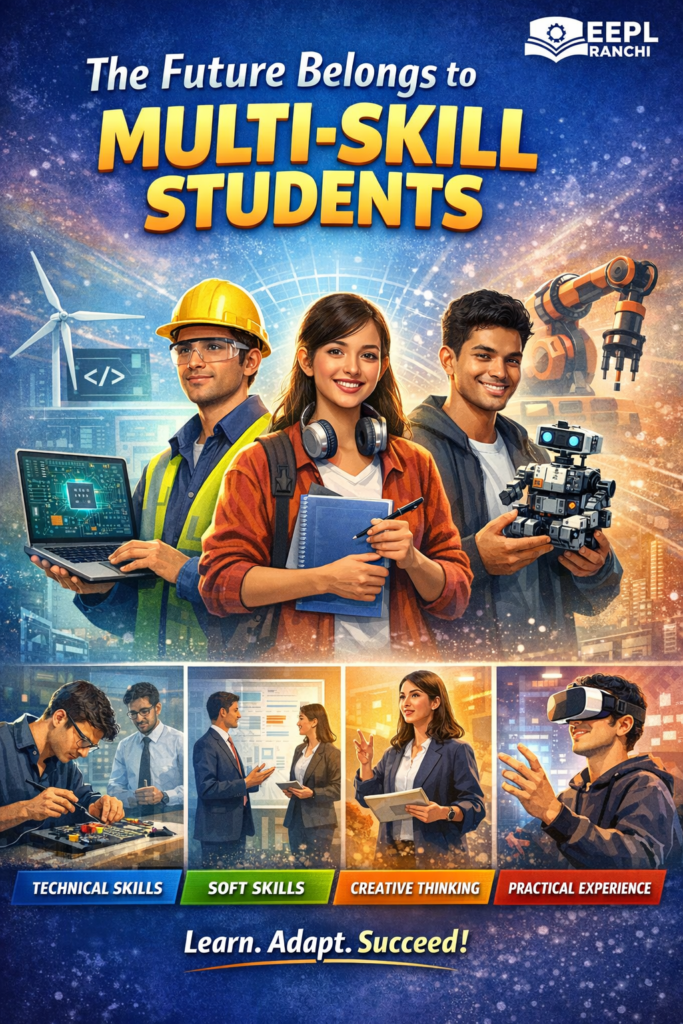
    Multi-skill students are learners who go beyond textbooks and classrooms. They focus on developing a balanced combination of abilities, including:

    • Technical skills such as programming, electronics, automation, or data analysis
    • Soft skills like communication, leadership, teamwork, and problem-solving
    • Creative and analytical thinking to innovate and adapt
    • Practical experience through projects, training, and hands-on learning

    These students are not afraid of change. Instead, they see new challenges as opportunities to learn and improve.

    Importance of Multi-Skill Development

    Being multi-skilled provides students with a strong advantage in both education and career growth. When students develop multiple competencies, they become more confident and flexible. They can easily adjust to new technologies, job roles, or industry demands.

    Multi-skill development also encourages independent thinking. Students learn how to approach problems from different angles and find effective solutions. This ability is especially important in competitive fields where innovation and adaptability determine success.

    Role of EEPL Ranchi in Shaping Multi-Skill Students

    EEPL Ranchi understands that education must go beyond theory. The institute focuses on skill-based learning that prepares students for real-world challenges. By integrating technical training with practical exposure and professional development, EEPL Ranchi helps students build a strong and versatile skill set.

    Students are encouraged to participate in hands-on projects, interactive sessions, and training programs that enhance both technical expertise and soft skills. This approach helps bridge the gap between academic learning and industry requirements, making students job-ready and future-focused.

    Benefits of Being a Multi-Skill Student

    The advantages of becoming a multi-skill student are long-lasting:

    1. Better career opportunities – Employers prefer candidates who can perform multiple roles effectively.
    2. Increased confidence – Learning diverse skills boosts self-belief and communication ability.
    3. Career flexibility – Multi-skilled individuals can shift between roles or industries more easily.
    4. Stronger problem-solving ability – Exposure to different skills enhances critical thinking.
    5. Continuous growth – Multi-skill students are lifelong learners who evolve with time.

    In a competitive job market, these benefits make a significant difference.

    Preparing for the Future

    The future workforce will belong to those who are willing to learn continuously and upgrade their skills. Automation, artificial intelligence, and digital transformation are redefining job roles. To stay relevant, students must adopt a growth mindset and actively work on developing multiple skills.

    Institutions like EEPL Ranchi play a crucial role in guiding students on this journey. By providing the right training, mentorship, and learning environment, they help students unlock their full potential.

    The future does not belong to those who limit themselves to one skill or one path. It belongs to multi-skill students who are adaptable, confident, and prepared for change. By combining technical knowledge with soft skills and practical experience, students can build successful and sustainable careers.

    At EEPL Ranchi, the focus is on shaping such future-ready individuals—students who are not just educated, but skilled, confident, and capable of leading tomorrow’s world.

    Because the future belongs to those who learn more, do more, and grow continuously.

    For More Information and Updates, Connect With Us

    Stay connected and keep learning with EEPL Classroom!
  • The Ultimate Academic Combo: NCERT, Practice, and Computer

    Success in academics is rarely about luck—it’s about strategy, consistency, and the right resources. Today, students face increasing competition in board exams, entrance tests, and skill-based assessments. To excel, one must combine strong concepts, regular practice, and smart technology usage. At EEPL Classes, we believe in a formula that consistently delivers results:

    NCERT + Practice + Computer = Winning Combo

    This simple yet powerful approach ensures students master concepts, apply them confidently, and perform at their best in exams.


    1. NCERT: The Foundation of Strong Concepts

    The National Council of Educational Research and Training (NCERT) textbooks are the cornerstone of India’s education system. Every topic is explained clearly, with a focus on fundamental concepts. However, many students skip NCERT thinking advanced reference books are enough.

    Why NCERT matters:

    • Provides clear, structured explanations
    • Covers the entire syllabus required for boards and competitive exams
    • Forms the basis for questions in JEE, NEET, CUET, and other entrance tests

    At EEPL Classes, students are encouraged to start with NCERT to build a solid foundation. Understanding concepts fully ensures students are ready for complex problems later.


    2. Practice: The Key to Excellence

    Concepts alone are not enough. Practice transforms knowledge into skill. Regular problem-solving and revision help students:

    • Reinforce concepts learned from NCERT
    • Improve speed and accuracy
    • Develop logical thinking and problem-solving skills
    • Identify weak areas and improve them

    EEPL Classes ensures students practice daily through assignments, worksheets, mock tests, and interactive exercises. This consistent practice builds confidence and prepares students for exams effectively.


    3. Computer: The Smart Learning Companion

    In today’s digital age, technology is an indispensable tool for learning. Computers and online resources allow students to:

    • Access interactive tutorials and animations
    • Solve practice problems faster and track performance
    • Learn coding, simulations, and virtual labs in STEM subjects
    • Stay updated with latest exam patterns and solutions

    EEPL Classes integrates computer-based learning to enhance understanding and make practice more engaging. This combination of traditional NCERT learning and technology ensures better retention and real-world application of concepts.


    4. How the Winning Combo Works Together

    Individually, NCERT, practice, and computers are powerful. Together, they create a holistic approach to learning:

    1. NCERT textbooks build a strong conceptual foundation.
    2. Regular practice turns that foundation into applied knowledge.
    3. Computer-assisted learning enhances understanding, tracks progress, and makes learning interactive and adaptive.

    This synergy ensures students are well-prepared for exams, confident in problem-solving, and capable of tackling advanced questions.


    5. EEPL Classes: Guiding Students to Success

    At EEPL Classes, we follow this winning formula for all our programs: NCERT + Practice + Computer. Our approach focuses on:

    • Structured syllabus coverage: Every topic from NCERT is explained in detail.
    • Daily practice routines: Worksheets, mock tests, and problem-solving sessions.
    • Tech-enabled learning: Interactive simulations, online quizzes, and coding exercises.
    • Personalized guidance: Experienced teachers identify student strengths and weaknesses.

    Students at EEPL Classes not only score high marks but also develop skills for competitive exams and lifelong learning.


    6. The Impact on Students

    The results speak for themselves. Students using this formula:

    • Score better in board exams and competitive tests
    • Develop analytical thinking and problem-solving skills
    • Gain confidence and motivation
    • Learn to study efficiently and smartly

    In short, combining NCERT, consistent practice, and computer-based learning transforms students into confident, skilled, and exam-ready learners.


    Conclusion: Adopt the Winning Combo Today

    Excellence in academics is no accident—it is the result of the right strategy and consistent effort. By combining NCERT textbooks, regular practice, and computer-based learning, students can maximize their understanding, retain knowledge longer, and perform exceptionally in all exams.

    EEPL Classes in Ranchi provides the perfect environment to implement this winning combo. Our structured guidance, practice routines, and tech-enabled learning ensure that students are not just prepared for exams, but prepared for success.

    Start today, follow the formula, and experience the difference:

    NCERT + Practice + Computer = Academic Success!

    For More Information and Updates, Connect With Us

    Stay connected and keep learning with EEPL Classroom!

  • The Crucial Role of Technology in Today’s World

    The Crucial Role of Technology in Today’s World

    Understanding Technology’s Evolution and Impact

    The evolution of technology is a remarkable journey that has fundamentally altered human existence. From the earliest tools fashioned by prehistoric humans to the complex digital systems we use today, technology has continually expanded the boundaries of possibility. Initially, simple inventions such as the wheel and lever enabled mankind to improve efficiency in transportation and construction, laying the groundwork for further innovations. This initial phase marked the beginning of a long-standing relationship between humanity and its creations, setting the stage for future technological advancements.

    As centuries passed, the Industrial Revolution ushered in a new era of technology characterized by mechanical inventions and automation. The steam engine, for instance, revolutionized transportation and manufacturing by enhancing productivity and enabling the mass production of goods. This era saw a significant shift not only in industrial practices but also in social structures, influencing urbanization and economic models. The emergence of electricity and later, telecommunications, reshaped how individuals communicated and interacted, bringing people closer together and facilitating the exchange of ideas on an unprecedented scale.

    With the dawn of the Information Age, technology took another transformative leap. The advent of personal computers and the internet created an interconnected global landscape. Today, we see the vast impact of technology across all sectors of society. Communication has become instantaneous, transportation is faster and more efficient, and daily life is more influenced by technological advancements than ever before. Innovations in areas such as artificial intelligence, biotechnology, and renewable energy continue to push the envelope, fostering a culture of progress and improvement. It is clear that technology is not just a tool but a critical component in shaping our modern era, influencing everything from education to healthcare.

    Enhancing Communication and Connectivity

    In the contemporary era, technology has fundamentally transformed the modalities through which we communicate and establish connections with others. The advent of the internet marked a pivotal shift in communication dynamics, making it possible for individuals to interact across vast geographical divides instantaneously. This era of connectivity enables us to share information and convey messages without the barriers that previously existed.

    Social media platforms have emerged as a dominant force in communication. They facilitate real-time interaction, allowing users to engage with friends, family, and colleagues regardless of their location. Networking opportunities are expanded as these platforms enable individuals to connect with people across the globe, fostering diverse interactions and collaborations. Moreover, mobile devices play a crucial role in this landscape, providing us with the ability to communicate at any time and from anywhere, which enhances our responsiveness and availability.

    The implications of these technological advancements extend beyond personal interactions; they also significantly impact businesses and educational institutions. Companies now leverage technology to communicate with clients and partners more efficiently. This innovation streamlines processes and enhances customer service while fostering a collaborative work environment. In educational contexts, technology facilitates remote learning and expands access to resources, supplementing traditional methods of teaching.

    Furthermore, enhanced connectivity nurtures interpersonal relationships by enabling people to maintain regular contact, share experiences, and support each other emotionally. Ultimately, the integration of technology into daily life has created a new era where communication transcends linguistic, cultural, and geographic boundaries, enriching our connections and enabling a global perspective.

    Driving Economic Growth and Innovation

    The role of technology in fostering economic growth and innovation cannot be overstated. In the modern era, advancements in technology have not only paved the way for new opportunities but have also transformed existing industries. Technology has been a catalyst for creating entirely new sectors, thus contributing significantly to overall economic development.

    For instance, the rise of the digital economy has led to the emergence of numerous tech startups, increasing competitive advantages for businesses. This boom has facilitated job creation, with millions finding employment in fields related to information technology, software development, and digital marketing. Moreover, established organizations have embraced technology to streamline operations, enhance productivity, and reduce costs, thereby leveraging technological innovation to gain a competitive edge.

    Innovative technologies such as artificial intelligence (AI), robotics, and big data analytics have significantly reshaped various sectors. AI and machine learning are being utilized to improve decision-making processes, from healthcare to finance, driving efficiency and better outcomes. Similarly, robotics has revolutionized manufacturing processes, enabling increased production speed while maintaining quality. Big data analytics provides organizations with valuable insights that enhance strategic planning and operational efficiency.

    However, the integration of such technologies also presents challenges. Issues such as job displacement due to automation and the digital divide among different socio-economic groups are significant concerns that need to be addressed. While technology provides opportunities for advancement and growth, it is essential to ensure that the benefits are equitably distributed across society. Therefore, stakeholders must prioritize responsible technology adoption, keeping in mind the broader implications on the workforce and the economy.

    In conclusion, technology plays a crucial role in driving economic progress and fostering innovation. Its impact is profound and multifaceted, indicating that navigating the challenges associated with technological advancements will be vital in maximizing their potential for economic enrichment.

    Addressing Global Challenges and Sustainability

    In the current era, technology plays a pivotal role in addressing pressing global challenges such as climate change, public health crises, and food security. The rapid advancements in technology have enabled innovative solutions that help mitigate environmental degradation and enhance overall sustainability. For instance, renewable energy technologies, such as solar and wind power, are transforming the energy sector, significantly reducing carbon emissions and improving energy efficiency.

    Moreover, in terms of public health, technologies such as telemedicine and mobile health applications have emerged as critical tools during health crises like the COVID-19 pandemic. These solutions have facilitated remote consultations, ensuring that communities continue to receive essential healthcare while minimizing virus transmission risks. Furthermore, data analytics and artificial intelligence are increasingly being utilized in epidemiology to predict outbreaks and optimize public health responses.

    A significant area where technology aids sustainability is in agriculture. Precision farming techniques, powered by drones and IoT devices, allow farmers to optimize resource use, reduce waste, and increase crop yields. These innovations not only enhance food security but also lessen the environmental impact of farming practices. For example, smart irrigation systems can minimize water consumption, and advanced soil sensors can help maintain soil health while reducing chemical runoff.

    Several projects globally illustrate the benefits of technology-driven initiatives. In various communities, the integration of clean cooking technologies is helping to reduce air pollution and improve health outcomes. Additionally, initiatives promoting urban farming through vertical gardens leverage technology to enhance local food production, decreasing dependency on long supply chains.

    In conclusion, as the global community faces distinct challenges, the role of technology in fostering sustainability and addressing these issues is more critical than ever. Through innovative solutions and collaborative efforts, technology paves the way for a more sustainable future, positively impacting countless lives across the globe.