Category: Blog

Your blog category

  • 10 Daily Sentences to Improve Your Spoken English

    Learning to speak English fluently does not always require complicated grammar rules or long study hours. Sometimes, the best way to improve your spoken English is by practicing simple sentences that you can use in everyday conversations. When you repeat useful sentences daily, your confidence grows and your speaking becomes more natural.

    we will look at 10 simple daily sentences that can help you improve your spoken English. Try to use these sentences regularly in your daily life.


    1. “How are you doing today?”

    This sentence is a polite way to greet someone and start a conversation. Instead of only saying “Hello,” you can ask this question to show interest in the other person. It is commonly used in both formal and informal conversations.

    Example:
    “How are you doing today? I hope everything is going well.”

    Practicing this sentence helps you begin conversations more confidently.


    2. “Can you please repeat that?”

    Sometimes we do not understand what someone says. Instead of staying silent, you can politely ask them to repeat it. This sentence is very useful in daily conversations, especially when learning English.

    Example:
    “Sorry, I didn’t catch that. Can you please repeat that?”

    Using this sentence helps you continue the conversation without feeling embarrassed.


    3. “I completely agree with you.”

    This sentence is helpful when you want to express agreement with someone’s opinion. It shows that you are listening carefully and respecting the other person’s ideas.

    Example:
    “I completely agree with you. Exercise is very important for good health.”

    Learning to express agreement clearly improves your communication skills.


    4. “In my opinion…”

    When you want to share your own thoughts or ideas, this phrase is very useful. It helps you express your opinion politely and confidently.

    Example:
    “In my opinion, reading books is one of the best ways to improve knowledge.”

    Using this phrase often will make your conversations more meaningful.


    5. “Could you help me with this?”

    Asking for help is a normal part of communication. This sentence is polite and commonly used in workplaces, schools, and daily situations.

    Example:
    “Could you help me with this project?”

    Practicing this sentence helps you ask for assistance without sounding rude.


    6. “I’m working on improving my English.”

    If you are learning English, this sentence is great for explaining your goal to others. Many people will appreciate your effort and may even help you practice.

    Example:
    “I’m working on improving my English, so I try to speak it every day.”

    This sentence can also motivate you to keep practicing.


    7. “Let me think about it.”

    Sometimes you need time before giving an answer. This sentence allows you to pause and think instead of responding quickly.

    Example:
    “That sounds like a good idea. Let me think about it.”

    Using this sentence helps you speak more thoughtfully.


    8. “That sounds interesting.”

    This sentence is useful when someone shares an idea, story, or plan. It shows interest and encourages the other person to continue talking.

    Example:
    “You are starting a new business? That sounds interesting.”

    Showing interest is an important part of good communication.


    9. “What do you mean?”

    If you are confused about something, you can ask this question to get clarification. It helps avoid misunderstandings during conversations.

    Example:
    “What do you mean by that statement?”

    Using this sentence helps improve your listening and understanding skills.


    10. “Thank you for your time.”

    Gratitude is an important part of communication. This sentence is especially useful in professional or formal situations.

    Example:
    “Thank you for your time. I really appreciate your help.”

    Practicing polite expressions like this makes you sound more professional and respectful.


    Tips to Practice These Sentences

    To improve your spoken English, try these simple practice methods:

    • Repeat the sentences aloud every day.
    • Use them in real conversations with friends or family.
    • Practice speaking in front of a mirror.
    • Record your voice and listen to your pronunciation.

    Consistency is the key to improvement. Even practicing for 10–15 minutes daily can make a big difference in your speaking skills.


    Improving spoken English does not have to be difficult. By practicing simple daily sentences, you can gradually build confidence and communicate more effectively. The 10 sentences shared in this blog are easy to learn and useful in many everyday situations.

    Start using these sentences today, and over time you will notice that speaking English becomes more comfortable and natural. Remember, the more you practice, the better you become. Keep learning, keep speaking, and enjoy the journey of improving your English.

    For More Information and Updates, Connect With Us

    Stay connected and keep learning with EEPL Classroom!

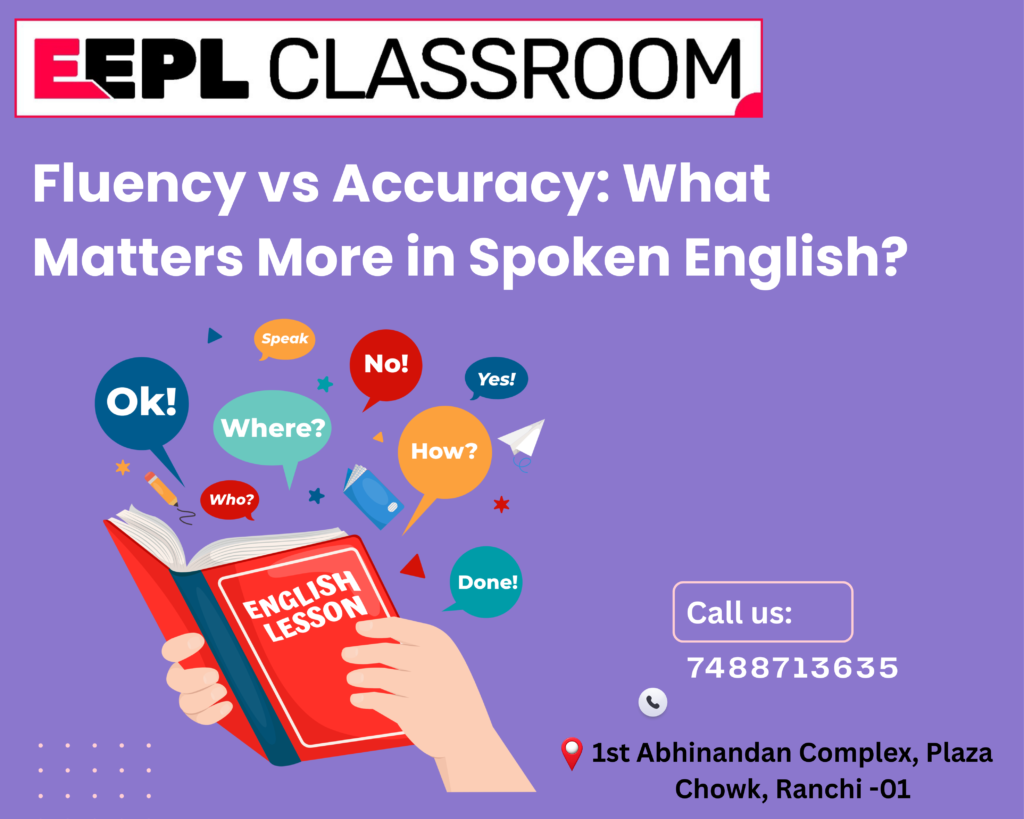
  • Fluency vs Accuracy: What Matters More in Spoken English?

    In today’s global world, English communication skills are extremely important for students, professionals, and job seekers. Whether it is a college interview, a job interview, or everyday conversation, the ability to speak English confidently can create many opportunities. However, many learners often face a common question while learning English: Is fluency more important or accuracy?

    Both fluency and accuracy are essential parts of spoken English, but understanding the difference between them can help learners improve their communication skills more effectively.

    What is Fluency in Spoken English?

    Fluency means the ability to speak English smoothly and confidently without too many pauses or hesitation. A fluent speaker can express thoughts easily and keep the conversation going naturally.

    Fluency focuses more on communication and confidence rather than perfect grammar. When someone speaks fluently, they may make small grammar mistakes, but they can still communicate their ideas clearly.

    For example, a fluent speaker might say:

    “Yesterday I go to market and buy many fruits.”

    Although the grammar is not perfect, the listener still understands the meaning of the sentence.

    Fluency helps people feel more confident while speaking and allows them to participate actively in conversations.

    What is Accuracy in Spoken English?

    Accuracy refers to speaking English with correct grammar, vocabulary, and pronunciation. An accurate speaker uses proper sentence structure and correct word forms while speaking.

    For example:

    “Yesterday I went to the market and bought many fruits.”

    This sentence is grammatically correct and uses proper verb forms.

    Accuracy is important because it helps speakers sound more professional and clear, especially in formal situations such as interviews, presentations, and academic discussions.

    Why Fluency is Important

    For many English learners, the biggest challenge is hesitation and fear of speaking. They worry too much about making mistakes and as a result they speak very little.

    Fluency helps overcome this problem. When learners focus on speaking freely and expressing their ideas, they become more confident.

    Fluent communication is important in situations like:

    • Group discussions
    • Everyday conversations
    • Networking and social communication
    • Classroom discussions

    In these situations, the main goal is to communicate ideas clearly, not necessarily to speak perfect English.

    Why Accuracy is Important

    While fluency helps with communication, accuracy ensures that the message is clear and professional. In formal environments such as job interviews or business meetings, accuracy becomes very important.

    Accurate English helps people:

    • Avoid misunderstandings
    • Sound professional
    • Build credibility and confidence
    • Improve writing and presentation skills

    For students preparing for competitive exams or professional careers, improving accuracy is essential.

    Finding the Right Balance

    The best approach to learning spoken English is balancing fluency and accuracy. Focusing only on fluency can lead to frequent grammar mistakes, while focusing only on accuracy can make learners hesitant to speak.

    A balanced approach allows learners to communicate confidently while gradually improving their grammar and vocabulary.

    For beginners, it is often helpful to start by focusing more on fluency. Once they become comfortable speaking English, they can work on improving accuracy step by step.

    Tips to Improve Both Fluency and Accuracy

    Students can improve their spoken English by following some simple and effective strategies.

    Practice speaking daily
    Regular speaking practice helps develop fluency. Try speaking with friends, teachers, or even practice speaking in front of a mirror.

    Listen to English regularly
    Watching English movies, listening to podcasts, and following English news channels can improve pronunciation and vocabulary.

    Learn basic grammar rules
    Understanding grammar basics helps improve accuracy in spoken English.

    Expand vocabulary
    Learning new words and phrases makes it easier to express ideas clearly.

    Record your speaking practice
    Recording your voice while speaking English can help you identify mistakes and improve pronunciation.

    Importance of Professional Guidance

    Many students struggle to improve their spoken English because they do not receive proper guidance or structured training. Learning from experienced trainers can help students develop both fluency and accuracy faster.

    Professional spoken English training programs focus on conversation practice, grammar improvement, vocabulary development, and confidence building.

    With the right training environment, students can overcome hesitation and become confident English speakers.

    Fluency and accuracy are both important aspects of spoken English. Fluency helps learners communicate confidently, while accuracy ensures that their language is correct and professional. Instead of choosing one over the other, students should focus on developing both skills gradually.

    With regular practice, consistent effort, and proper guidance, anyone can improve their English communication skills and speak confidently in any situation.

    If you want to improve your spoken English, communication skills, and interview confidence, get admission at EEPL Classroom in Ranchi. With expert trainers, practical speaking sessions, and structured learning methods, students can develop both fluency and accuracy and prepare themselves for academic and career success.

    For More Information and Updates, Connect With Us

    Stay connected and keep learning with EEPL Classroom!
  • Common Mistakes Students Make During Board Exams

    Board exams are one of the most important milestones in a student’s academic journey. Whether it is Class 10 or Class 12, these exams play a crucial role in shaping future education and career opportunities. However, many students make small but common mistakes during board exams that affect their final results. These mistakes are often not related to lack of knowledge but due to poor planning, stress, or lack of exam strategy.

    Understanding these common mistakes can help students avoid them and perform much better in their exams. With the right preparation, proper guidance, and smart exam strategies, students can improve their confidence and achieve excellent scores.

    Poor Time Management

    One of the most common mistakes students make during board exams is poor time management. Many students spend too much time on difficult questions and then struggle to complete the remaining paper.

    It is important to divide your time wisely during the exam. Start with questions that you know well and complete them quickly. This builds confidence and ensures that you secure easy marks first. After that, move on to moderate and difficult questions.

    Students should also keep the last few minutes for revision to check for any mistakes or unanswered questions.

    Not Reading the Question Properly

    Another major mistake students make is not reading the question carefully. Sometimes students understand the question incorrectly and write answers that do not match what is asked.

    For example, a question might ask for “explain,” “list,” or “compare,” and each requires a different type of answer. Missing such details can lead to loss of marks even if the student knows the topic.

    Always read the question twice before answering and underline important keywords to avoid confusion.

    Ignoring Presentation

    Presentation plays a very important role in board exams. Even if your answer is correct, poor presentation can make it difficult for the examiner to understand.

    Students should write answers clearly and neatly. Use headings, bullet points, and proper spacing wherever possible. Drawing diagrams, charts, or tables when required can also improve the quality of the answer.

    A well-presented answer sheet creates a positive impression and can help students score better marks.

    Leaving Questions Unanswered

    Some students skip questions because they are unsure about the answer. Leaving questions blank can result in a direct loss of marks.

    Even if you are not completely sure about the answer, try to write something related to the topic. Partial answers can still earn some marks.

    Always attempt every question if possible.

    Not Practicing Previous Year Papers

    Many students focus only on reading textbooks and notes but do not practice previous year question papers. This is a big mistake because solving past papers helps students understand the exam pattern and commonly asked questions.

    Practicing previous papers also improves writing speed and time management during exams.

    Students who regularly practice sample papers feel more confident and prepared when they sit for the actual exam.

    Overconfidence or Lack of Confidence

    Both overconfidence and lack of confidence can affect exam performance.

    Some students feel overconfident and reduce their study effort, thinking they already know everything. On the other hand, some students doubt their preparation and feel nervous during exams.

    The best approach is to stay balanced. Prepare consistently and trust your preparation. Confidence combined with hard work leads to better results.

    Poor Revision Strategy

    Many students focus only on studying new topics and forget the importance of revision. Without revision, it becomes difficult to remember important concepts during exams.

    Students should revise important formulas, definitions, and key points regularly. Creating short notes or summary sheets can help during last-minute revision.

    Effective revision improves memory and helps students recall information quickly during exams.

    Exam Stress and Panic

    Stress is common during board exams, but excessive stress can affect concentration and performance.

    Students should try to stay calm and positive during the exam. Deep breathing and positive thinking can help reduce anxiety.

    Proper sleep, healthy food, and regular breaks during study time also help maintain a healthy mindset.

    Lack of Proper Guidance

    Sometimes students struggle because they do not receive proper guidance for exam preparation. Having experienced teachers and structured study plans can make preparation easier and more effective.

    With the right guidance, students learn how to manage time, understand concepts better, and prepare strategically for exams.

    Board exams are important, but they do not have to be stressful. By avoiding common mistakes such as poor time management, ignoring presentation, skipping questions, and not practicing previous papers, students can significantly improve their exam performance.

    Success in board exams depends not only on how much you study but also on how smartly you prepare and perform during the exam.

    If you want expert guidance, regular tests, and a structured preparation plan, get admission at EEPL Classroom in Ranchi. With experienced faculty, quality study materials, and continuous support, students can prepare confidently and achieve excellent results in their board exams.

    Start your journey toward academic success today by joining EEPL Classroom Ranchi and learning with the right guidance.

    For More Information and Updates, Connect With Us

    Stay connected and keep learning with EEPL Classroom!
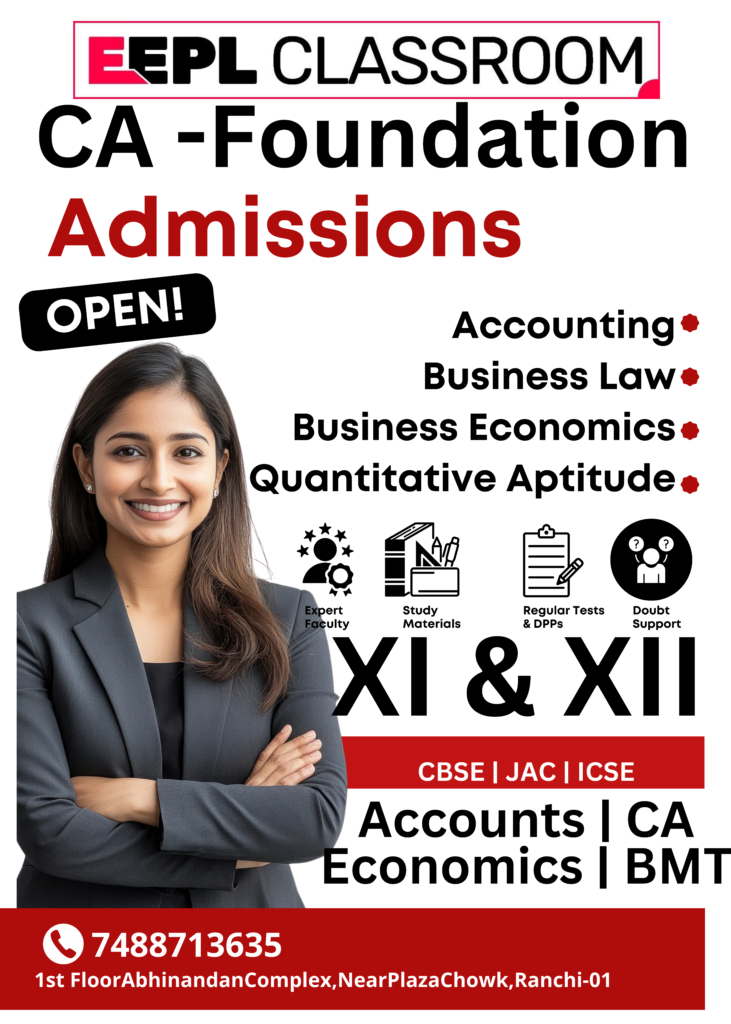
  • CA Foundation Coaching for Class XI & XII in Ranchi

    Choosing the right career after school is one of the most important decisions for students. For commerce students who dream of becoming a Chartered Accountant, starting preparation early can make a huge difference. The CA Foundation is the first step toward becoming a Chartered Accountant, and building a strong base during Class XI and XII can help students succeed in this competitive journey.

    If you are a commerce student in Ranchi looking for expert guidance, EEPL Classroom offers a structured learning program designed specifically for CA Foundation aspirants and commerce students.

    Why Start CA Foundation Preparation in Class XI?

    Many students start preparing for CA Foundation only after completing Class 12, but starting earlier gives students a significant advantage. When preparation begins in Class XI, students get more time to understand the core concepts of commerce subjects.

    Subjects like Accounting, Business Law, Economics, and Quantitative Aptitude require strong conceptual understanding and regular practice. Early preparation helps students develop analytical skills, problem-solving ability, and exam confidence.

    At EEPL Classroom, students receive step-by-step guidance that helps them understand both board exam concepts and CA Foundation fundamentals simultaneously.

    Subjects Covered for Commerce Students

    A strong academic foundation is essential for commerce students who want to succeed in professional courses. The program focuses on the most important subjects required for both Class XI & XII board exams and CA Foundation preparation.

    The key subjects include:

    Accounting
    Accounting is the backbone of commerce education. Students learn journal entries, ledger posting, financial statements, and important accounting principles that are essential for CA Foundation and future finance careers.

    Business Law
    Business Law helps students understand the legal framework related to business operations. Learning these concepts early makes it easier to grasp advanced CA Foundation topics.

    Business Economics
    Economics helps students understand how markets function, how demand and supply work, and how economic policies affect businesses and industries.

    Quantitative Aptitude
    Quantitative Aptitude develops mathematical and analytical skills required for solving numerical problems quickly and accurately.

    These subjects not only help students perform well in board exams but also build a strong base for professional courses.

    Expert Faculty and Structured Learning

    One of the biggest advantages of joining EEPL Classroom is the guidance provided by experienced faculty members who understand the challenges faced by commerce students.

    Teachers focus on simplifying complex concepts and explaining them in a practical and easy-to-understand manner. Students are encouraged to ask questions and actively participate in discussions to strengthen their understanding.

    Expert mentorship helps students stay motivated and focused throughout their academic journey.

    Study Materials Designed for Success

    Quality study material plays a major role in exam preparation. Students at EEPL Classroom receive carefully prepared study resources that cover important concepts, practice questions, and exam-oriented content.

    These materials are designed to help students:

    • Understand key concepts clearly
    • Practice exam-style questions
    • Improve accuracy and speed
    • Revise important topics effectively

    Structured learning resources make preparation more organized and productive.

    Regular Tests and Performance Evaluation

    Regular assessment is essential to track progress and identify areas that need improvement. Students are given regular tests and DPPs (Daily Practice Problems) that help them practice consistently.

    These tests help students:

    • Improve exam speed
    • Develop time management skills
    • Identify weak areas
    • Build confidence for final exams

    Consistent testing ensures that students stay on track and maintain steady progress.

    Doubt Support and Personalized Attention

    Every student learns at a different pace. Some topics may require extra attention and explanation. That is why doubt support is an important part of the learning process.

    At EEPL Classroom, students receive dedicated doubt-clearing sessions where teachers explain difficult topics in detail. This personalized attention helps students overcome learning challenges and strengthen their concepts.

    Suitable for CBSE, JAC, and ICSE Students

    The program is designed for students from major education boards, including:

    • CBSE
    • JAC
    • ICSE

    This ensures that students receive guidance aligned with their school syllabus while also preparing for competitive professional exams.

    A Step Toward a Successful Career

    The journey to becoming a Chartered Accountant requires dedication, discipline, and the right guidance. Starting preparation during Class XI and XII can give students a strong academic advantage and improve their chances of success in CA Foundation.

    With expert faculty, structured study materials, regular tests, and continuous support, students can build a strong base in commerce subjects and move confidently toward their professional goals.

    Admissions Open – Start Your Commerce Journey Today

    If you are a commerce student planning a career in accounting, finance, or chartered accountancy, this is the perfect time to start your preparation.

    Join EEPL Classroom and learn from experienced mentors who are committed to helping students succeed in Accounts, Economics, Business Studies, and CA Foundation preparation.

    Admissions are now open for Class XI & XII students.
    Take the first step toward a successful commerce career and begin your preparation with the right guidance today.

    For More Information and Updates, Connect With Us

    Stay connected and keep learning with EEPL Classroom!

  • How to Solve Difficult MCQs Faster in Competitive Exams

    Competitive exams are becoming more challenging every year. Exams such as entrance tests(Neet ,Jee), government exams, and various aptitude tests often include multiple-choice questions (MCQs) that test not only knowledge but also speed and accuracy. Many students know the answers but struggle to solve difficult MCQs within the limited time available in the exam.

    Learning the right techniques can help students solve tough MCQs faster and improve their overall score. With smart strategies, regular practice, and good time management, students can handle even the most difficult questions confidently.

    Understand the Question Carefully

    The first step to solving difficult MCQs quickly is understanding the question properly. Many students make mistakes because they rush and misread the question.

    Always read the question carefully and identify what exactly is being asked. Pay attention to keywords such as not, except, correct, incorrect, or best answer. These small words can completely change the meaning of the question.

    Taking a few extra seconds to understand the question can save valuable time later.

    Eliminate Wrong Options

    One of the most effective strategies for solving MCQs is the elimination method. Instead of trying to directly find the correct answer, start by removing the options that are clearly incorrect.

    For example, if there are four options and you eliminate two wrong ones, your chances of choosing the correct answer increase significantly.

    This technique works especially well when you are unsure about the exact answer but have a general understanding of the topic.

    Improve Time Management

    Time management is crucial in competitive exams. Students should avoid spending too much time on a single difficult question.

    A good strategy is to follow the three-round approach:

    1. Solve easy questions first
    2. Attempt moderate questions in the second round
    3. Return to difficult questions at the end

    This method ensures that you secure marks from questions you already know before spending time on tougher ones.

    Practice Previous Year Question Papers

    Practicing previous year question papers is one of the best ways to prepare for competitive exams. These papers help students understand the exam pattern, difficulty level, and commonly asked topics.

    By solving past papers regularly, students can improve their speed and become familiar with the types of MCQs that appear in exams.

    It also helps identify weak areas that require more practice.

    Strengthen Your Basic Concepts

    Many difficult MCQs are actually based on basic concepts. If your fundamentals are strong, solving complex questions becomes much easier.

    Instead of memorizing answers, focus on understanding the logic behind each concept. When the concept is clear, you can quickly analyze the question and find the correct option.

    Strong conceptual understanding also helps students handle tricky questions that are designed to confuse candidates.

    Use Smart Guessing

    Sometimes, students may not know the exact answer but still need to choose an option. In such cases, smart guessing can be helpful.

    Smart guessing means using logical thinking to choose the most probable answer. By eliminating incorrect options and analyzing the remaining ones, students can make an educated guess.

    However, this strategy should be used carefully, especially if the exam includes negative marking.

    Improve Calculation Speed

    In exams that involve numerical questions, slow calculations can consume a lot of time. Practicing mental math and shortcut techniques can help students solve problems faster.

    Learning quick calculation methods, approximation techniques, and basic formulas can significantly improve speed and accuracy.

    Regular practice is the key to developing fast calculation skills.

    Stay Calm During the Exam

    Stress and panic can reduce concentration and lead to mistakes. Even well-prepared students sometimes perform poorly because they become nervous during the exam.

    Maintaining a calm and focused mindset is extremely important. If you encounter a difficult question, do not panic. Move to the next question and return later with a fresh perspective.

    Confidence and a positive attitude help students think clearly and make better decisions during exams.

    Practice Regularly

    Like any skill, solving MCQs quickly improves with practice. The more questions you solve, the more familiar you become with different patterns and problem types.

    Daily practice also improves:

    • Speed
    • Accuracy
    • Confidence
    • Logical thinking

    Students who practice regularly develop the ability to analyze questions quickly and choose the correct answers efficiently.

    Solving difficult MCQs faster in competitive exams requires a combination of smart strategies, strong concepts, and consistent practice. By carefully reading questions, eliminating wrong options, managing time effectively, and practicing previous papers, students can significantly improve their performance.

    Remember that success in competitive exams is not only about knowledge but also about speed, accuracy, and strategy. With the right preparation and mindset, students can tackle even the toughest MCQs confidently and achieve excellent results.

    Want expert guidance for competitive exam preparation? Get admission at EEPL Ranchi today and start learning with experienced mentors.

    For More Information and Updates, Connect With Us

    Stay connected and keep learning with EEPL Classroom!
  • How Toppers Prepare 3 Months Before Board Exams

    Board exams are one of the most important milestones in a student’s academic journey. Many students feel stressed as the exam date approaches, especially during the last three months. However, toppers often use this time very strategically. Instead of studying randomly, they follow a well-planned routine that helps them revise effectively, strengthen weak areas, and improve their confidence before the exams.

    If you want to score high marks in your board exams, learning how toppers prepare during the final three months can help you create a smart study strategy.

    1. Creating a Proper Study Plan

    One of the most important habits of toppers is planning their study schedule. They divide the remaining three months into smaller sections and assign specific topics to each week.

    A good study plan includes time for:

    • Revising important chapters
    • Practicing sample papers
    • Solving previous year question papers
    • Taking short breaks

    Instead of studying everything at once, toppers focus on completing subjects step by step. This approach helps reduce stress and improves concentration.

    2. Strengthening Basic Concepts

    Toppers always focus on understanding concepts clearly rather than memorizing everything. During the last three months, they revise important concepts from each chapter and make sure they understand the basics.

    When concepts are clear, it becomes easier to solve different types of questions in the exam. Students who focus only on memorization often struggle when questions are slightly changed.

    3. Practicing Previous Year Question Papers

    Another strategy used by toppers is practicing previous year question papers. These papers help students understand the exam pattern, marking scheme, and frequently asked questions.

    By solving past papers, students can:

    • Improve time management
    • Understand important topics
    • Identify weak areas
    • Gain confidence before exams

    Practicing under exam-like conditions also helps students prepare mentally for the real exam environment.

    4. Regular Revision

    Revision plays a crucial role in exam preparation. Toppers revise important topics multiple times to ensure they remember them during the exam.

    A common revision technique is the 3-step method:

    1. First reading to understand the topic
    2. Second revision to strengthen memory
    3. Final revision before the exam

    This method helps students retain information for a longer time.

    5. Making Short Notes

    Toppers often create short notes, formulas, and summary sheets while studying. These notes are extremely helpful during the final days before exams.

    Short notes help students quickly revise:

    • Important formulas
    • Key definitions
    • Important points from each chapter

    This saves time and makes revision more efficient.

    6. Solving Mock Tests

    Mock tests are an important part of exam preparation. Toppers regularly take mock tests to evaluate their performance.

    Mock tests help students:

    • Improve writing speed
    • Learn time management
    • Reduce exam fear
    • Identify areas that need improvement

    After each mock test, toppers analyze their mistakes and work on improving them.

    7. Staying Consistent and Avoiding Procrastination

    Consistency is one of the biggest reasons behind the success of toppers. Instead of studying for long hours occasionally, they study regularly every day.

    They also avoid distractions like excessive social media or unnecessary activities during the exam preparation period. Staying focused and disciplined helps them cover the syllabus effectively.

    8. Maintaining Good Health

    Preparing for board exams does not mean studying all the time without rest. Toppers understand the importance of good physical and mental health.

    They make sure to:

    • Get enough sleep
    • Eat healthy food
    • Take short breaks between study sessions
    • Stay physically active

    A healthy body and mind help students stay focused and perform better in exams.

    9. Asking Doubts Without Hesitation

    Whenever toppers face difficulty understanding a topic, they immediately ask teachers or mentors for help. Clearing doubts early prevents confusion later.

    Students should never hesitate to ask questions because solving doubts improves understanding and confidence.

    10. Staying Positive and Confident

    Finally, toppers always maintain a positive mindset. They believe in their preparation and stay confident about their performance.

    Instead of worrying about the exam, they focus on improving their preparation every day. Confidence and self-belief play a big role in achieving good results.

    The last three months before board exams are extremely important for every student. With the right planning, regular revision, and consistent practice, students can significantly improve their performance.

    Toppers succeed not because they study harder, but because they study smarter. By following a structured study plan, practicing previous papers, making short notes, and maintaining a positive attitude, any student can perform well in board exams.

    Remember, success in board exams is not about studying all the time but about studying with the right strategy and dedication. With focus, discipline, and smart preparation, you can achieve excellent results and move confidently toward your future goals.

    For More Information and Updates, Connect With Us

    Stay connected and keep learning with EEPL Classroom!
  • Career Options After Class 12: How Skill-Based Courses Can Shape Your Future

    Completing Class 12 is a major milestone in every student’s life. After this stage, students often face an important question: What should I do next? With so many career options available today, choosing the right path can sometimes feel confusing. However, one thing is clear—developing practical skills has become just as important as earning a degree.

    In today’s competitive world, skill-based education plays a key role in building successful careers. Skill-based courses help students gain practical knowledge, improve their abilities, and prepare for real-world job opportunities. By combining academic education with practical training, students can build a strong foundation for their future.

    Understanding the Importance of Skill-Based Courses

    Traditional education mainly focuses on theoretical knowledge. While theory is important, employers today are looking for candidates who also have practical skills and hands-on experience.

    Skill-based courses help students learn technologies, tools, and techniques that are widely used in modern industries. These courses focus on practical learning, project work, and real-life problem solving. As a result, students become more confident and job-ready.

    Many students after Class 12 choose professional training programs to learn programming, computer applications, communication skills, and other technical subjects.

    Popular Career Options After Class 12

    There are many career paths students can explore depending on their interests and academic background. Some of the most popular options include engineering, business studies, computer science, and professional skill courses.

    Students who are interested in technology can pursue courses related to software development and programming. Learning languages such as Python and Java can open doors to careers in software development, web development, and IT services.

    Students can also explore emerging fields like Data Science, artificial intelligence, and digital technologies, which are growing rapidly in today’s technology-driven world.

    Benefits of Learning Technical Skills Early

    Learning technical skills at an early stage provides several advantages. Students gain practical experience that helps them understand how technology works in real-world environments.

    Technical training also improves problem-solving abilities and logical thinking. When students work on projects and coding exercises, they develop the ability to analyze problems and create effective solutions.

    Another benefit is that students become familiar with industry tools and development environments, which makes it easier for them to adapt when they enter professional workplaces.

    Building a Strong Portfolio

    A strong portfolio is very helpful when applying for internships or entry-level jobs. Skill-based courses encourage students to build real projects that demonstrate their knowledge and abilities.

    For example, students learning programming can create small applications, websites, or software tools. These projects can be shared on platforms like GitHub, where employers can review their work.

    A good portfolio not only shows technical skills but also reflects creativity, dedication, and practical experience.

    Improving Communication and Professional Skills

    In addition to technical knowledge, communication skills are also very important for career growth. Many skill-based courses include training in spoken English, presentation skills, and interview preparation.

    These skills help students express their ideas clearly, work effectively in teams, and perform confidently during job interviews.

    Students who develop both technical and communication skills are more prepared to succeed in professional environments.

    Why Choose EEPL Classroom for Skill-Based Training

    Students who want to build strong technical and professional skills can consider joining EEPL Classroom. EEPL Classroom provides practical training programs designed to help students gain industry-relevant knowledge and experience.

    The courses focus on hands-on learning, real projects, and career preparation. Students receive guidance from experienced trainers who help them understand programming concepts and modern technologies in a simple and practical way.

    By enrolling in skill-based programs at EEPL Classroom, students can develop the confidence and abilities needed to start successful careers in the technology industry.

    Choosing the right career path after Class 12 is an important decision that can shape a student’s future. While traditional degrees remain valuable, combining them with skill-based training can significantly improve career opportunities.

    Skill-based courses help students gain practical experience, build strong portfolios, and develop essential professional skills. Whether it is programming, technology, or communication training, learning these skills early can make a big difference in career growth.

    Students who invest time in developing practical skills can explore many exciting opportunities in the modern job market. By joining professional training programs like those offered at EEPL Classroom, students can take the first step toward building a bright and successful future.

    For More Information and Updates, Connect With Us

    Stay connected and keep learning with EEPL Classroom!

  • Best Career Skills Class 11 Students Should Start Learning Early

    Class 11 is an important stage in a student’s academic journey. It is the time when students begin to think seriously about their future careers and the skills they need to succeed. While school education provides a strong academic foundation, developing additional skills early can give students a major advantage in the competitive world of careers.

    Learning important career skills in Class 11 helps students build confidence, improve their knowledge, and prepare for future opportunities. By starting early, students can explore their interests and develop abilities that will benefit them throughout their academic and professional lives.

    Communication Skills

    One of the most valuable skills students should develop is communication. Good communication helps students express their ideas clearly, participate in discussions, and build strong relationships with teachers and peers.

    Strong communication skills are also essential for job interviews, presentations, and teamwork. Students who practice speaking, listening, and writing regularly become more confident and better prepared for professional environments.

    Improving communication skills early can help students perform better in school and later in college or workplace situations.

    Basic Computer Skills

    In today’s digital world, computer knowledge is essential for almost every career. Students in Class 11 should start learning basic computer skills such as using office software, creating presentations, and managing digital information.

    Understanding how computers work also helps students explore technology-based careers. Learning tools like Microsoft Excel and Microsoft PowerPoint can improve productivity and help students complete assignments more effectively.

    These skills are widely used in both education and professional settings.

    Programming and Coding

    Learning programming at an early stage can open many career opportunities. Coding helps students understand how software and applications are created. It also improves logical thinking and problem-solving abilities.

    Students can begin learning programming languages like Python or Java, which are widely used in software development and technology industries.

    Coding skills allow students to create small projects such as simple applications, websites, or automation tools. These experiences build confidence and prepare students for advanced technical learning in the future.

    Critical Thinking and Problem Solving

    Another important skill for Class 11 students is critical thinking. This skill helps students analyze situations, evaluate information, and make logical decisions.

    Problem-solving abilities are essential in many careers, especially in fields like engineering, technology, and business. Students who develop strong analytical thinking can handle challenges more effectively and come up with innovative solutions.

    Activities like solving puzzles, participating in debates, and working on projects can help improve these skills.

    Time Management

    Time management is a crucial skill for academic success. Students in Class 11 often have to balance schoolwork, extracurricular activities, and personal interests.

    Learning how to manage time effectively helps students stay organized and complete tasks on schedule. It also reduces stress and improves productivity.

    Students can develop time management skills by creating daily schedules, setting goals, and prioritizing important tasks.

    Teamwork and Collaboration

    Modern workplaces require employees to work together on projects and solve problems as a team. Therefore, teamwork is an essential skill students should start developing early.

    Group activities, school projects, and extracurricular programs help students learn how to cooperate with others, share ideas, and respect different perspectives.

    Students who learn teamwork skills early become better collaborators and leaders in their future careers.

    Digital Literacy

    Digital literacy means understanding how to use technology effectively and responsibly. Students should learn how to search for information online, evaluate digital content, and use technology safely.

    Digital literacy also includes understanding basic concepts of emerging fields such as Artificial Intelligence and Data Science. Having awareness of these fields can help students explore new career possibilities in the future.

    As technology continues to grow, digital literacy will remain an essential skill for almost every profession.

    By joining professional training programs like those offered at EEPL Classroom, students can take the first step toward building a bright and successful future.

    For More Information and Updates, Connect With Us

    Stay connected and keep learning with EEPL Classroom!
  • How Coding Skills Can Help Students Build Successful Careers

    In the modern digital era, technology plays an important role in almost every industry. From education and healthcare to finance and entertainment, software and digital systems are shaping how businesses operate. Because of this rapid technological growth, coding has become one of the most valuable skills students can learn today. Coding not only helps students understand technology but also opens the door to many career opportunities.

    Learning coding allows students to build applications, solve real-world problems, and develop innovative solutions. As industries continue to depend on technology, coding skills are becoming a key factor in building successful and rewarding careers.

    Understanding the Basics of Programming

    Coding is the process of writing instructions that computers follow to perform tasks. These instructions are written in programming languages such as Python, Java, and JavaScript. Each language is designed to solve different types of problems and create various kinds of applications.

    When students start learning programming, they develop logical thinking and problem-solving skills. They learn how to break down complex problems into smaller steps and create solutions using code. These abilities are extremely valuable not only in technology fields but also in many other professional areas.

    Expanding Career Opportunities

    One of the biggest advantages of learning coding is the wide range of career options it provides. Skilled programmers are in high demand across many industries, including software development, data analysis, cybersecurity, and web development.

    Students who know how to code can pursue roles such as software developer, web developer, data analyst, or automation engineer. Coding skills also create opportunities in emerging fields like Artificial Intelligence and Data Science, where programming knowledge is essential.

    As technology continues to evolve, the demand for skilled programmers is expected to grow even further, making coding a future-proof skill for students.

    Encouraging Innovation and Creativity

    Coding is not just about writing technical instructions—it is also a creative activity. Developers use coding to build websites, mobile applications, games, and software tools that solve real-world problems.

    Students who learn coding can create their own digital projects, such as educational apps, online platforms, or automation tools. These projects allow them to experiment with new ideas and bring their creativity to life through technology.

    Innovation is highly valued in the modern workplace, and coding gives students the ability to turn their ideas into practical solutions.

    Building a Strong Professional Portfolio

    A strong portfolio is extremely important when applying for internships or entry-level jobs. Coding allows students to create real projects that demonstrate their abilities and practical experience.

    Students can upload their projects to platforms like GitHub, where they can showcase their work to potential employers. A portfolio with well-developed projects shows that a student has hands-on experience and the ability to solve real technical problems.

    Employers often prefer candidates who can demonstrate practical skills through projects rather than relying only on theoretical knowledge.

    Developing Problem-Solving Skills

    Coding helps students develop strong analytical and problem-solving abilities. Writing code requires careful planning, logical thinking, and attention to detail.

    When programmers encounter errors or bugs, they must analyze the issue and find solutions to fix it. This process improves critical thinking and teaches students how to approach challenges methodically.

    These problem-solving skills are valuable in almost every profession and help students become more confident when dealing with complex tasks.

    Preparing Students for the Future

    The world is becoming increasingly digital, and technology will continue to influence every aspect of our lives. Learning coding prepares students for the future by helping them understand how digital systems work.

    Even students who do not plan to become professional programmers can benefit from coding knowledge. Many careers today require at least basic technical skills, and coding helps students stay competitive in the modern job market.

    By learning programming early, students gain an advantage that can support their career growth in the long term.

    For More Information and Updates, Connect With Us

    Stay connected and keep learning with EEPL Classroom!

  • Essential Technical Skills Every IT Student Should Develop

    In today’s digital world, the demand for skilled IT professionals is growing rapidly. Companies are constantly looking for talented individuals who can develop software, manage data, and create innovative technology solutions. For students pursuing courses like BCA, B.Tech, or other computer science programs, developing the right technical skills is essential for building a successful career in the IT industry.

    Learning technical skills not only helps students understand how technology works but also prepares them for real-world job roles. Here are some of the most important technical skills every IT student should develop.

    Programming Skills

    Programming is the foundation of most IT careers. Students should learn at least one or two programming languages to build strong coding skills. Popular languages like Java, Python, and C++ are widely used in the software industry.

    Learning programming helps students understand how applications and software systems are developed. It also improves logical thinking and problem-solving abilities. Students should practice coding regularly and work on small programs or projects to strengthen their programming skills.

    Data Structures and Algorithms

    Data structures and algorithms are important concepts in computer science. They help programmers organize data efficiently and solve complex problems quickly. Understanding concepts like arrays, stacks, queues, linked lists, and sorting algorithms helps students write optimized code.

    Many companies test these concepts during technical interviews. Students who have a strong understanding of data structures and algorithms often perform better in coding tests and interviews.

    Database Management

    Almost every modern application works with data. Therefore, IT students must learn how to store, manage, and retrieve data using databases. Learning database technologies like MySQL helps students understand how information is organized and accessed in applications.

    Students should also learn SQL queries to perform operations such as inserting, updating, and retrieving data. Knowledge of databases is essential for backend development, data analysis, and enterprise applications.

    Web Development Skills

    Web development is one of the most popular areas in the IT industry. Students should learn the basics of front-end and back-end development to build websites and web applications.

    Front-end technologies include HTML, CSS, and JavaScript, which are used to design user interfaces. For back-end development, students can learn frameworks such as Spring Boot, which is commonly used with Java for building scalable web applications.

    Learning web development allows students to create real projects and understand how modern websites and applications work.

    Version Control and Collaboration

    In professional software development, teams often work together on large projects. Version control systems help developers manage changes in code and collaborate efficiently. Learning Git and platforms like GitHub allows students to track code changes, collaborate with other developers, and maintain project history.

    Using version control tools also helps students build an online portfolio where they can showcase their projects to potential employers.

    Problem-Solving and Debugging

    Debugging is an essential skill for programmers. While writing code, developers often encounter errors or unexpected behavior in their programs. Knowing how to identify and fix these problems is an important part of software development.

    Students should practice solving coding challenges and debugging programs. This improves analytical thinking and prepares them for real-world development tasks.

    Understanding Software Development Tools

    IT students should become familiar with development environments and tools used by professionals. Tools like Eclipse IDE and IntelliJ IDEA help developers write, test, and debug code more efficiently.

    Learning these tools helps students understand how real software development environments work. It also increases productivity when working on coding projects.

    Practical Project Experience

    One of the most effective ways to develop technical skills is by working on real projects. Projects help students apply theoretical knowledge to practical problems. For example, students can build applications like a student management system, online store, or personal portfolio website.

    Working on projects improves coding skills, creativity, and confidence. It also helps students build a strong portfolio that can be presented during job interviews.

    By learning modern tools, practicing coding regularly, and working on real projects, students can build a strong technical foundation. These skills not only improve their knowledge but also increase their chances of getting internships and job opportunities in the competitive IT field.

    With dedication, continuous learning, and practical experience, IT students can prepare themselves for exciting careers in software development, data science, cybersecurity, and many other technology domains.

    For More Information and Updates, Connect With Us

    Stay connected and keep learning with EEPL Classroom!