The circular flow of income is a fundamental concept in commerce and economics that explains how money, goods, and services move within an economy. It shows the continuous movement of income between different sectors such as households, firms, government, and the foreign sector. Understanding this concept helps students analyze how an economy functions and how different sectors are interdependent.
What is Circular Flow of Income?
The circular flow of income refers to the continuous movement of money and resources between producers and consumers in an economy. It illustrates how income is generated and spent repeatedly, creating a cycle.
In simple terms:
- Households provide factors of production (land, labor, capital)
- Firms use these factors to produce goods and services
- Firms pay wages, rent, interest, and profit to households
- Households spend this income on goods and services
This creates a continuous loop or “circular flow.”
Two-Sector Model (Basic Economy)
The simplest form of the circular flow is the two-sector model, which includes:
1. Households
Households are consumers. They provide labor and other resources to firms and earn income in return.
2. Firms
Firms produce goods and services. They pay income to households and receive money when households buy their products.
Flow in Two-Sector Model:
- Households → provide resources → Firms
- Firms → pay wages → Households
- Households → spend money → Firms
This creates a simple and continuous cycle of income and expenditure.
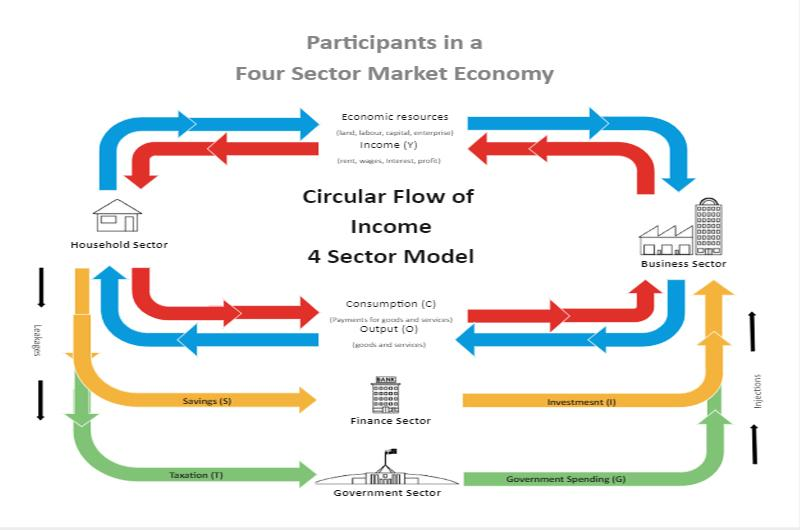
Four-Sector Model (Real Economy)
In reality, the economy is more complex and includes four sectors:
1. Households
Consumers who spend money on goods and services.
2. Firms
Producers who create goods and services.
3. Government
The government collects taxes and spends on public services like education, health, and infrastructure.
4. Foreign Sector
Includes imports and exports with other countries.
Flow in Four-Sector Model:
- Government collects taxes and provides services
- Firms and households interact with foreign countries through trade
- Imports and exports affect the flow of income
This model gives a more realistic picture of how economies operate.
Leakages and Injections
The circular flow is affected by two important factors:
Leakages
These are withdrawals from the flow of income:
- Savings
- Taxes
- Imports
Leakages reduce the flow of money in the economy.
Injections
These are additions to the flow:
- Investment
- Government spending
- Exports
Injections increase the flow of income.
For an economy to remain stable, leakages and injections should be balanced.
Importance of Circular Flow of Income
Understanding the circular flow of income is important for several reasons:
1. Explains Economic Activity
It shows how production, income, and expenditure are connected.
2. Helps in Policy Making
Governments use this concept to design economic policies related to taxation and spending.
3. Measures National Income
It helps in understanding how national income is generated and distributed.
4. Shows Interdependence
It highlights how households, firms, and government depend on each other.
Real-Life Example
Consider a simple example:
- A worker is employed by a company and earns a salary
- The worker uses this money to buy goods from the market
- The company receives this money and uses it to pay wages and invest in production
This cycle continues, forming the circular flow of income.
Limitations of the Model
Although useful, the circular flow model has some limitations:
- It assumes a simplified economy
- It may ignore real-world complexities like inflation
- It does not fully explain income inequality
Despite these limitations, it remains a powerful tool for understanding basic economic concepts.
The circular flow of income is a key concept in commerce that explains how money and resources move in an economy. It shows the continuous interaction between households, firms, government, and the foreign sector.
By understanding this concept, students can better analyze economic activities, policies, and the functioning of markets. It provides a clear picture of how income is generated, distributed, and spent, making it essential for anyone studying commerce or economics.
For More Information and Updates, Connect With Us
- Name Survi kumari
- Phone Number: +91-7488713635
- Email ID: survi.eeplclassroom@gmail.com
- Our Platforms:
- Digilearn Cloud
- EEPL Test
- Live Emancipation
- Follow Us on Social Media:
- Instagram – EEPL Classroom
- Facebook – EEPL Classroom
Stay connected and keep learning with EEPL Classroom!

Leave a Reply