Newton’s First Law of Motion is one of the fundamental principles of physics that explains the concept of inertia. This law, often called the Law of Inertia, describes how objects behave when no external force acts on them. It forms the foundation for understanding motion and is widely used in everyday life and scientific applications.
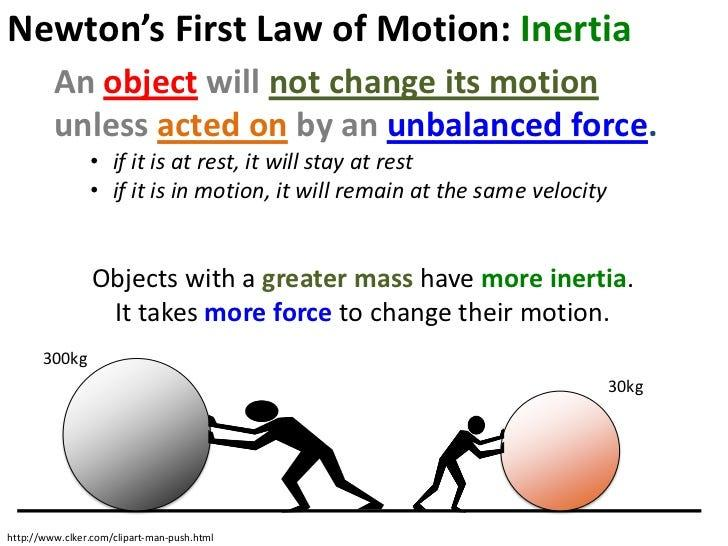
What is Newton’s First Law?
Isaac Newton stated his First Law of Motion as:
“An object at rest stays at rest, and an object in motion continues in motion with the same speed and direction unless acted upon by an external force.”
In simple terms, objects do not change their state of motion on their own. They require an external force to start moving, stop moving, or change direction.
Understanding Inertia
Inertia is the property of a body that resists any change in its state of rest or motion. It means that an object will continue doing what it is already doing unless something forces it to change.
There are three types of inertia:
1. Inertia of Rest
An object at rest tends to remain at rest.
Example: A book lying on a table will not move unless someone pushes it.
2. Inertia of Motion
An object in motion continues to move with the same velocity unless acted upon by an external force.
Example: A moving bicycle will keep rolling unless brakes are applied.
3. Inertia of Direction
An object moving in a particular direction tends to continue in that direction.
Example: A ball thrown forward keeps moving in a straight path unless forces like gravity or air resistance act on it.
Everyday Examples of Inertia
Newton’s First Law can be observed in many daily situations:
1. Sudden Stop in a Bus
When a moving bus stops suddenly, passengers tend to fall forward. This happens because their bodies were in motion and want to continue moving due to inertia.
2. Dusting a Carpet
When you beat a carpet, dust particles come out. The dust was at rest and tends to remain at rest while the carpet moves, causing the dust to separate.
3. Coin and Card Experiment
If you place a coin on a card over a glass and flick the card quickly, the coin falls straight into the glass. The coin remains at rest due to inertia while the card moves away.
4. Use of Seatbelts
Seatbelts in cars prevent passengers from moving forward during sudden braking. They counteract inertia and ensure safety.
Why is Inertia Important?
Inertia is an essential concept because it helps explain how objects behave in the absence of forces. Its importance includes:
- Understanding motion and rest
- Designing safety systems like seatbelts and airbags
- Explaining natural phenomena
- Forming the basis for advanced physics concepts
Without the concept of inertia, it would be difficult to predict how objects move in the real world.
Factors Affecting Inertia
The amount of inertia an object has depends on its mass:
- More mass = More inertia
- Less mass = Less inertia
For example, a heavy truck is harder to stop than a bicycle because it has greater inertia.
External Forces and Change in Motion
According to Newton’s First Law, a change in motion only occurs when an external force acts on an object. These forces can include:
- Push or pull
- Friction
- Gravity
- Air resistance
Without these forces, objects would continue in their current state indefinitely.
Applications in Real Life
The concept of inertia is widely used in practical applications:
- Vehicle safety systems (seatbelts, airbags)
- Sports (ball movement, running)
- Engineering (designing machines and structures)
- Space science (motion of planets and satellites)
In space, where there is very little friction, objects continue moving for long distances due to inertia.
Newton’s First Law of Motion clearly explains the concept of inertia—the tendency of objects to resist changes in their state of motion. Whether an object is at rest or in motion, it will continue in that state unless an external force acts upon it.
From everyday experiences like riding a bus to advanced scientific applications, inertia plays a crucial role in understanding how the physical world works. By studying this law, we gain deeper insight into motion, forces, and the behavior of objects around us.
For More Information and Updates, Connect With Us
- Name Survi kumari
- Phone Number: +91-7488713635
- Email ID: survi.eeplclassroom@gmail.com
- Our Platforms:
- Digilearn Cloud
- EEPL Test
- Live Emancipation
- Follow Us on Social Media:
- Instagram – EEPL Classroom
- Facebook – EEPL Classroom
Stay connected and keep learning with EEPL Classroom!

Leave a Reply