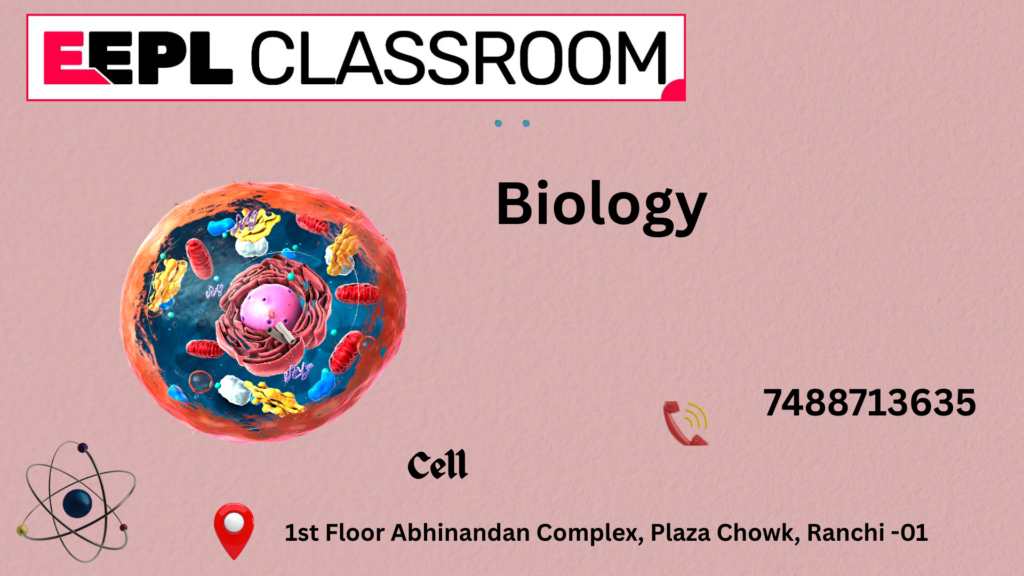
The cell is the basic structural and functional unit of life. Every living organism, whether a tiny bacteria or a large elephant, is made up of cells. Cells are considered the “building blocks of life” because all life processes take place within them.
Understanding cells is very important in biology because they help us learn how living organisms grow, reproduce, and function.
Discovery of the Cell
The discovery of the cell was made possible by the invention of the microscope. In 1665, Robert Hooke first observed a thin slice of cork under a microscope and discovered small box-like structures, which he named “cells.” Later, scientists like Anton van Leeuwenhoek improved the microscope and discovered living cells.
This discovery opened the door to modern biology.
What is a Cell?
A cell is the smallest unit of life that can perform all basic life functions. It is the structural and functional unit of all living organisms.
Cells are responsible for:
- Growth
- Reproduction
- Energy production
- Repair and maintenance
Without cells, life cannot exist.
Types of Cells
Cells are mainly classified into two types:
1. Prokaryotic Cells
These are simple and primitive cells without a well-defined nucleus.
Characteristics:
- No true nucleus
- No membrane-bound organelles
- Small in size
- Found in bacteria
Example: Bacteria
2. Eukaryotic Cells
These are complex cells with a well-defined nucleus.
Characteristics:
- True nucleus present
- Membrane-bound organelles present
- Larger in size
- Found in plants, animals, and fungi
Example: Human cells, plant cells
Structure of a Cell
A typical cell has three main parts:
1. Cell Membrane
It is the outer covering of the cell. It controls the entry and exit of substances.
2. Cytoplasm
It is a jelly-like substance inside the cell where all cell activities take place.
3. Nucleus
It is the control center of the cell. It contains genetic material (DNA) and controls all functions of the cell.
Cell Organelles and Their Functions
Cells contain small structures called organelles, each performing specific functions:
- Mitochondria: Produces energy (known as powerhouse of the cell)
- Ribosomes: Helps in protein synthesis
- Endoplasmic Reticulum: Helps in transport of materials
- Golgi Apparatus: Packages and distributes proteins
- Lysosomes: Breaks down waste materials
- Vacuoles: Stores food, water, and waste
Each organelle plays an important role in keeping the cell alive and functioning.
Plant Cell vs Animal Cell
There are some differences between plant and animal cells:
Plant Cell:
- Has a cell wall
- Contains chloroplast (for photosynthesis)
- Usually rectangular in shape
- Large vacuole present
Animal Cell:
- No cell wall
- No chloroplast
- Irregular shape
- Smaller vacuoles
These differences help plants and animals perform their unique functions.
Functions of Cells
Cells perform many essential functions such as:
- Providing structure to organisms
- Producing energy
- Carrying out metabolic activities
- Helping in growth and repair
- Reproduction of new cells
All life processes depend on the proper functioning of cells.
Cell Theory
Cell theory is an important concept in biology. It was proposed by Schleiden, Schwann, and Virchow.
It states that:
- All living organisms are made up of cells
- The cell is the basic unit of life
- All cells come from pre-existing cells
This theory is the foundation of modern biology.
Importance of Cells
Cells are important because:
- They form the structure of all living organisms
- They carry out life processes
- They help in growth and development
- They enable reproduction
- They maintain life functions
Without cells, life as we know it would not exist.
The cell is truly the unit of life and the foundation of all living organisms. From the smallest bacteria to the largest animals, everything is made up of cells. Each cell performs essential functions that keep organisms alive and functioning.
Understanding cells helps us learn how life works at the microscopic level. It is one of the most important topics in biology and forms the base for advanced studies in life sciences.
By studying cells, we gain a deeper understanding of how life is organized, how organisms grow, and how biological processes take place in every living being.
For More Information and Updates, Connect With Us
- Name Survi kumari
- Phone Number: +91-7488713635
- Email ID: survi.eeplclassroom@gmail.com
- Our Platforms:
- Digilearn Cloud
- EEPL Test
- Live Emancipation
- Follow Us on Social Media:
- Instagram – EEPL Classroom
- Facebook – EEPL Classroom
Stay connected and keep learning with EEPL Classroom!

Leave a Reply